

How To Clean Deleted Files From Hard Drive

When you delete a file normally in Windows, it's not really gone for good. Learn how to securely erase files and folders so they're unrecoverable.
When you delete a file in Windows, it may seem like it's gone for good. But, unless you securely erase a file, it can be recovered. This is because Windows doesn't actually remove the file from your hard drive when you delete it. Only the reference to the file is removed from the file system table. The file is still on the drive until another file writes over it. Therefore, anyone can easily recover a deleted file using a disk maintenance tool or a file recovery utility like Recuva.
It gets worse; even after a file is overwritten while saving more files to your hard drive, it might still be recoverable if enough fragments of the file exist and the person making a recovery has the right technical know-how and tools.
We've previously covered how to use CCleaner to delete files securely. Today we'll cover seven other free tools for Windows that help you securely erase data from your hard drive so it can't be recovered. Several of these tools are portable and can be stored on a USB flash drive. Portable secure erase tools are useful if you often use public computers.
Some of these tools also allow you to securely wipe the free space on your hard drive, making any files and folders you erased without using a secure method unrecoverable.
1. Eraser
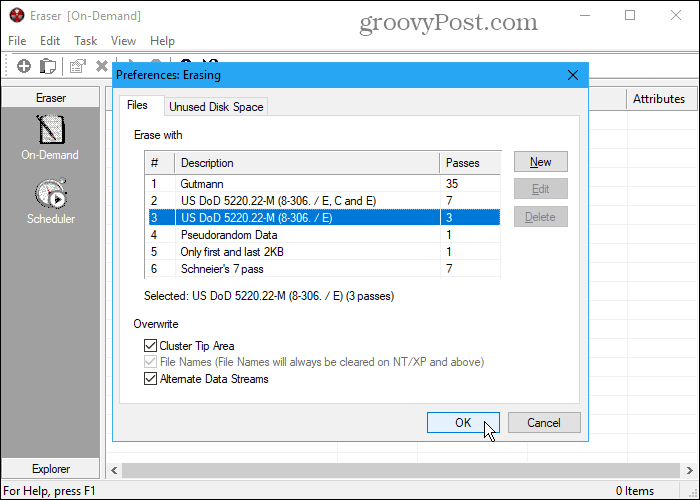
Eraser is a free tool that allows you to completely and securely delete sensitive data from your hard drive. It overwrites the data several times using one of six methods, including the US DoD 5220.22-M standard with three passes or seven passes and the Gutmann method with 35 passes. Go to Edit > Preferences > Erasing and select the method on the Files tab. You can even add your own custom methods.
Be aware that if you select the Gutmann method in Eraser (or in any of the other tools listed below), the secure deletion process may take a long time.
Add files to Eraser to delete them immediately using the On Demand interface. Or use the Scheduler to automatically securely delete the selected files at a later time.
If you don't want to install Eraser, download the portable version of Eraser. You won't get the right-click menu option in File Explorer. But you still get the On-Demand and Scheduler features for securely deleting files and folders in the software.
You can also integrate Eraser into File Explorer, allowing you to select files in Explorer, right-click on them, and securely erase them. To do this, you must use the installable version of Eraser.
2. Secure Eraser
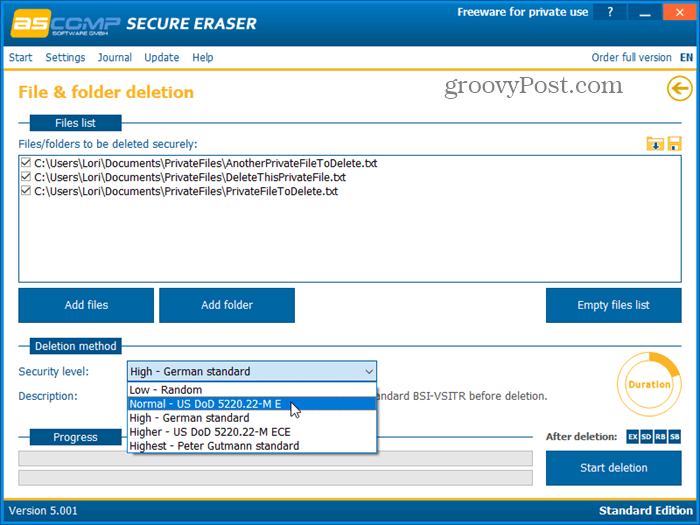
Secure Eraser is an easy-to-use program that allows you to securely erase data from your Windows computer using one of five different security levels. Your data will be overwritten up to 35 times, making it unrecoverable, even with specialized software. Select the Security level you want under the Deletion method.
The Report administration feature maintains a log of all operations and generates a detailed report displayed in your default browser.
You can also use Secure Eraser to delete a drive or partition securely and securely wipe the free space on your hard drive or even to clean the registry or your system.
When you use the free Standard Edition, you'll be prompted to buy the full version after each deletion. But, if you don't mind seeing the message every time, you can continue to use the free Standard Edition for personal use. To remove the message, purchase the Professional version for $20 for a private license or $40 for a company license.
3. Freeraser
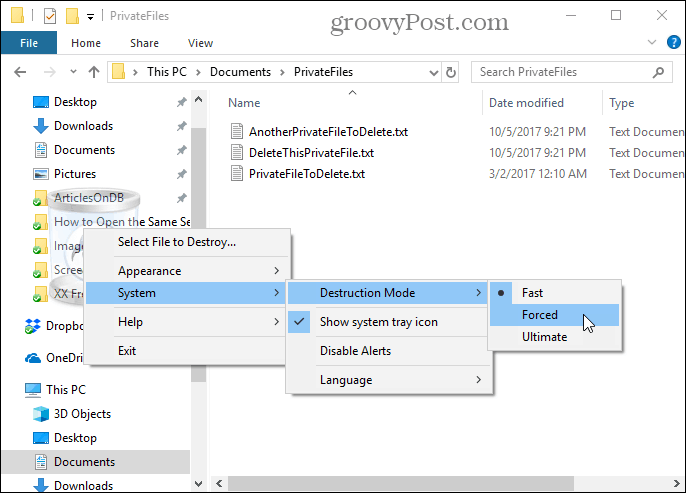
Freeraser is a free, portable tool that allows you to securely delete files directly in File Explorer using drag-and-drop. When you run the program, you'll see a trash can icon on your desktop that sits on top of all other windows. Drag your files and folders to the icon to securely delete them.
Right-click on the icon to manually select files to destroy, change the Appearance, or change System settings like the Destruction Mode.
The program offers three destruction modes for securely deleting your data. The Fast method overwrites the files once with random data. To overwrite the data three times according to the DoD 5220.22-M standard, select Forced. Selecting the Ultimate method overwrites the deleted files and folders 35 times according to the Gutmann method.
4. File Shredder
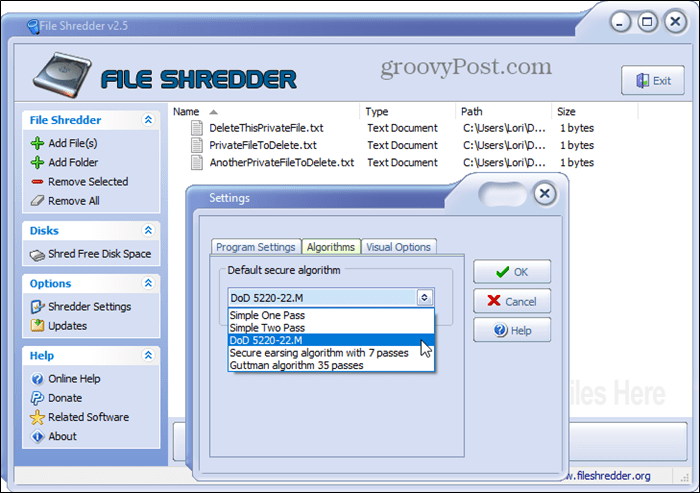
File Shredder is a free, straightforward program that allows you to erase files securely and securely wipe free disk space.
The program provides five different methods for securely deleting files that include one pass, two passes, the DoD 5220.22-M method (three passes), 7 passes, and the Gutmann algorithm (35 passes). Go into the Shredder Settings and select one of these options on the Algorithms tab.
You can also integrate File Shredder into File Explorer. This allows you to select files and folders to delete them in Explorer, right-click on them, and securely delete them from the context menu. Go into the Shredder Settings and check the Enable Shell Integration box on the Program Settings tab.
5. SecureDelete
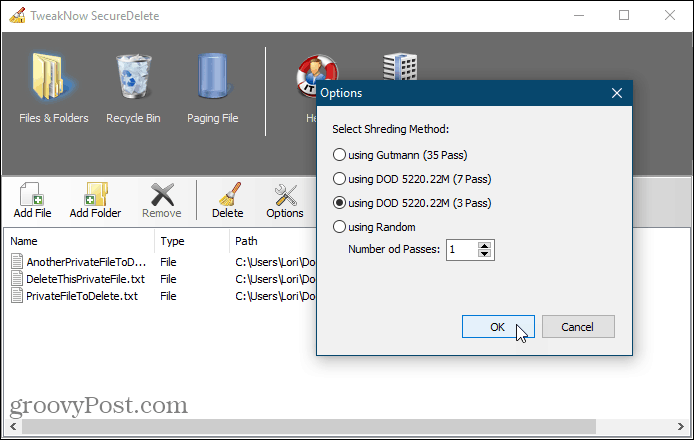
SecureDelete is an easy-to-use free program that allows you to securely delete files and folders using one of four shredding methods. You can choose one of the DoD 5220.22-M methods (3 passes or 7 passes), the Gutmann method (35 passes), or overwrite the deleted files and folders with random data using a custom number of passes.
Click Options to select the method you want to use. Then, click Add File to add one or more files or Add Folder to add an entire folder to the list. To delete the added files or folders, click Delete.
If you've deleted some files normally and they're still in the Recycle Bin, you can securely delete those files too. Click the Recycle Bin icon in SecureDelete and then click Empty Recycle Bin.
Windows uses a paging file on your hard disk as additional backup memory when you have no more physical memory left. But, unlike physical memory, the paging file is not automatically cleared when you shut down your computer. It remains available, and anyone with enough know-how can access the data in the paging file.
SecureDelete offers an option to clear the paging file automatically when you shut down your computer. To set this up, click Paging File and select Enable from the Clear paging file at shutdown drop-down list. Then, click Save. Restart your computer to finish applying the change.
6. Blank And Secure
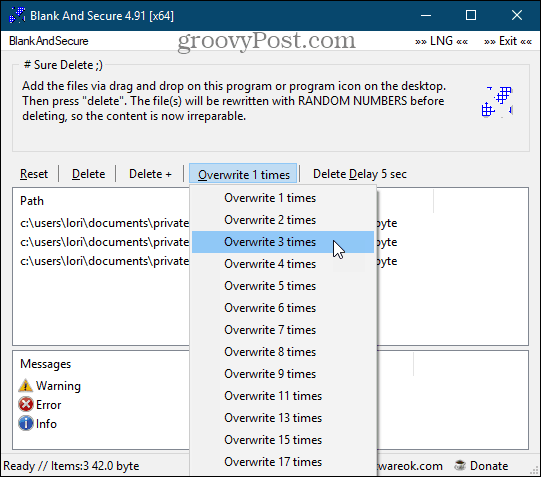
Blank And Secure is a free, portable tool for securely deleting files. Before deleting your files, select the number of times you want to Overwrite the files with random numbers. They don't use the DoD 5220.22-M and Gutmann methods. You can also choose a Delete Delay of up to nine seconds.
Drag and drop the files or folders you want to delete onto the program window and click Delete. Use the Delete + button if you want to end the program, shut down your PC, put your PC in standby mode, or end the program and put the PC in standby mode after securely deleting the files.
Click Reset if you decide not to securely delete the selected files and folders and want to remove them from the program.
7. SDelete
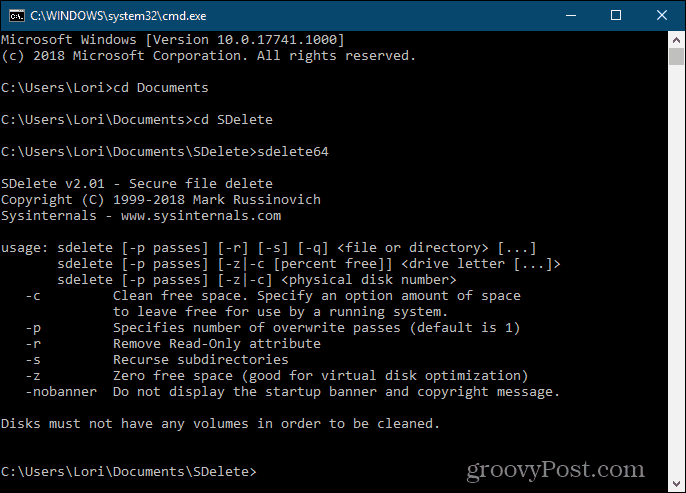
For those of you who like using the command line, we have SDelete, one of Microsoft's Sysinternals tools. The program uses the Department of Defense clearing and sanitizing standard DoD 5220.22-M. You can specify how many passes you want SDelete to perform when it deletes files and directories. The default number of passes is one.
SDelete is portable and can be run from a USB flash drive.
In File Explorer, open the folder containing the extracted SDelete program files. Then, to open a command prompt window to the current folder, type: cmd.exe in the address bar in File Explorer and press Enter.
To get instructions on using the command, type: sdelete or sdelete64 (depending on whether you're running a 32-bit or 64-bit version of Windows, respectively) and press Enter.
Secure Your Data, Even When Deleting It
Secure delete tools are as important as other tools that protect your privacy, like password managers (for example, KeePass and 1Password) and VPNs and getting in the habit of creating strong passwords. Decide which tool is your favorite and keep it handy for deleting your private and sensitive data.
Do you like the secure delete tools we listed here? Have you found any other tools for securely deleting files? Please share your thoughts and findings with us in the comments below!

How To Clean Deleted Files From Hard Drive
Source: https://www.groovypost.com/howto/7-free-ways-securely-delete-files-windows/
Posted by: maxwelldayse1969.blogspot.com
0 Response to "How To Clean Deleted Files From Hard Drive"
Post a Comment